Regional bus-driver training facility wins $15 million federal grant

A Kitsap Transit bus driver practices backing up at Gordon Field in Bremerton.
Kitsap Transit will receive a $15 million grant from the Federal Transit Administration to build a regional bus-driver training facility that will enhance public safety and support transit agencies in Kitsap and neighboring counties, officials announced.
The training facility is one of 34 bus and bus facilities projects nationwide that are receiving nearly $390 million, the Federal Transit Administration announced last month.
“Transit helps reduce traffic congestion, improve road safety, and promotes regional economic growth, but it doesn’t work without a well-trained corps of bus drivers,” said John Clauson, Kitsap Transit’s Executive Director. “This training facility will help us recruit and retain outstanding bus drivers and dispatchers who provide safe, reliable service to passengers riding on transit in Kitsap County and beyond. It also gives us classroom space to train our mechanics who are critical to our vehicles’ reliability.”
Kitsap Transit currently lacks a dedicated training facility. As a result, new bus operators and dispatchers must train in a scattered assortment of maintenance yards, classrooms, and office spaces that aren’t reliably available or may require equipment from another location. There are also no dedicated bus-driver training facilities in Pierce, Mason, Jefferson, Clallam, or Lewis counties.
“We know robust public transit means more foot traffic for small businesses, less congestion on our roads, and better connected communities—and a strong, well-trained transit workforce is foundational to keeping our communities and our economy moving,” said U.S. Sen. Patty Murray. “That’s why I’m proud to help deliver $15 million for Kitsap Transit to construct a new bus-driver training facility that will support the needs of our bus drivers and dispatchers who make sure we all get to where we’re going safely. Investments like this make a real difference in people’s everyday commutes, and I’ll keep working to deliver federal resources to Washington communities that need them most.”
“Investing in a dedicated bus operator training facility will help Kitsap Transit more efficiently train drivers and strengthen transit service across Western Washington,” said U.S. Sen. Maria Cantwell. “Kitsap Transit ridership is surging, with 3.3 million rides last year. This federal investment will help meet rising ridership demand while ensuring operators have the skills and resources they need to keep passengers safe.”
“Investing in public transit is good for all of us – it means cleaner air, easier commutes to the doctor or to work, and growing our economy with living wage Union jobs,” said U.S. Rep. Emily Randall. “This new facility will provide world-class training to ease our bus driver shortage and help neighbors get where they need to go – whether that’s a military family getting from Bangor to Bremerton, a high school student headed to work in Silverdale, or a senior getting to the grocery store.”
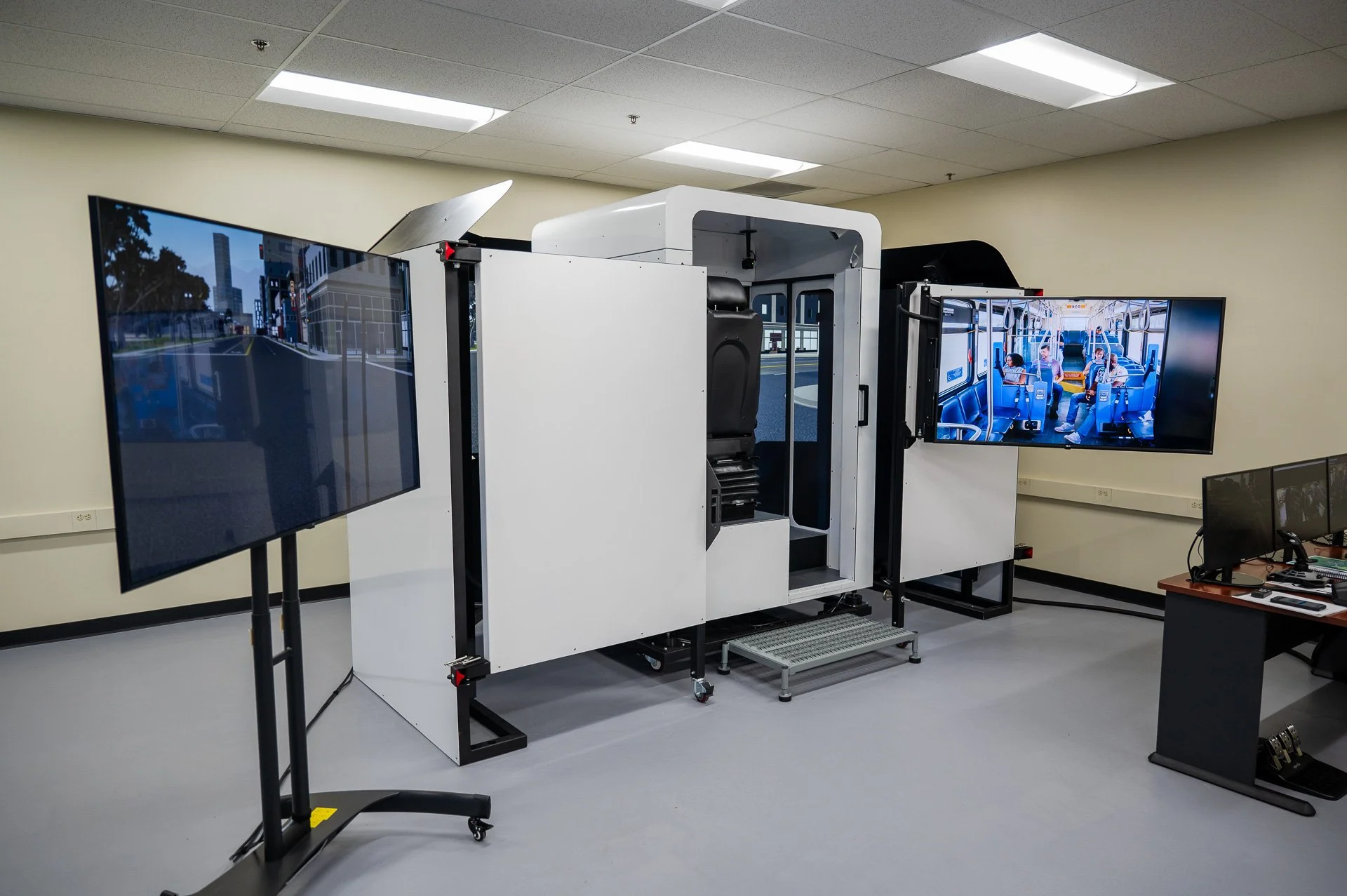
Kitsap Transit’s bus simulator.
KT’s current plans call for an 8.4-acre training site to be located on a vacant parcel in the Puget Sound Industrial Center next to an Amazon distribution center. Kitsap Transit is in the process of acquiring the property and plans to seek construction bids next year for a 10,000-square-foot building that will include classrooms, a simulator training room, locker rooms, and office spaces.
The cutting-edge simulator, which is currently located at Kitsap Transit’s Gateway Center in Bremerton, incorporates actual maps of the agency’s fixed-route service area and allows trainees to experience different roadway conditions, weather, and passenger capacity.
The training site will also feature two driving courses where trainees can practice driving buses for various scenarios and obtain the training hours required for a Commercial Driver License (CDL). Under the current plans, construction would be completed in late 2028.
As designed, the total project’s cost is $33 million, which includes property acquisition and construction costs. Kitsap Transit will contribute $3.75 million in local funds. To address the project’s unfunded portion, the agency will seek additional grants and may reduce the project’s scale.